
The hardest accounting classes in college rank in this definitive order: 1) Intermediate Accounting II, 2) Advanced Accounting, 3) Cost & Managerial Accounting, 4) Federal Income Taxation, 5) Auditing & Attestation, 6) Intermediate Accounting I, and 7) Accounting Information Systems (AIS). Intermediate Accounting II is the consensus #1 weed-out course due to dense GAAP standard volume and high attrition.
Every year, thousands of students declare an accounting major, drawn by starting salaries and Big Four job offers. Yet, by junior year, lecture halls lose up to 45% of their students. Business schools call this the accounting weed-out phenomenon.
Here is the truth after fifteen years of teaching college accounting: students do not fail because of math. College accounting math is simple arithmetic and introductory algebra. Students struggle because upper-level classes demand abstract regulatory logic, dense standard codifications, and cascading calculations. If you miscalculate one lease liability or miss one deferred tax asset, your entire balance sheet fails to balance.
This faculty guide ranks the accounting curriculum by true difficulty. We examine key failure points in GAAP rules like ASC 842, ASC 606, and corporate eliminations. We also outline realistic study workloads and share a proven recovery plan for tough midterms.
The Difficulty Matrix: Accounting Classes Ranked at a Glance
Curriculum design varies slightly across colleges. Yet, the core conceptual hurdles remain consistent. The table below outlines the seven core accounting courses. Each is rated by difficulty, drop risk, and weekly study time.
| Course Name | Difficulty (Out of 10) | Primary "Weed-Out" Topic | Avg. Weekly Study Hours | Historical Pass Rate |
|---|---|---|---|---|
| Intermediate Accounting II | 10 / 10 | ASC 842 Leases, Pensions & Dilutive Securities | 11 – 14 hrs | 58% – 66% |
| Advanced Accounting | 9.5 / 10 | Consolidations, Eliminations & Foreign Currency | 10 – 13 hrs | 65% – 72% |
| Cost & Managerial Accounting | 9.0 / 10 | Variance Analysis, ABC & Equivalent Units | 9 – 12 hrs | 62% – 70% |
| Federal Income Taxation | 8.5 / 10 | Book-to-Tax Reconciliations (M-1/M-3) & Basis | 8 – 11 hrs | 70% – 76% |
| Auditing & Assurance Services | 8.0 / 10 | COSO Internal Controls & Audit Risk Model ($AR$) | 7 – 10 hrs | 74% – 80% |
| Intermediate Accounting I | 8.0 / 10 | ASC 606 Revenue Recognition & Time Value of Money | 8 – 11 hrs | 68% – 75% |
| Accounting Information Systems (AIS) | 7.5 / 10 | Systems Understanding Aid (SUA) & Relational SQL | 8 – 12 hrs | 80% – 86% |
Notice the direct link between study hours and pass rates. In Intermediate II and Cost Accounting, cramming leads to failure. The material builds weekly. Missing five days of practice creates a gap you cannot close before test day.
Course-by-Course Deep Dives: Why Students Fail and How to Pass
To pass these tough courses, you must know where students stumble. Below is a breakdown of specific traps, accounting rules, and study moves for each class.
1. Intermediate Accounting II (The Ultimate Weed-Out Course)
Faculty, advisors, and students agree: Intermediate Accounting II is the toughest business class. While Intermediate Accounting I focuses on asset valuation, Intermediate II covers long-term debt, complex equity transactions, and detailed FASB disclosures.
The Core Friction Points:
- ASC 842 (Lease Accounting): Students must separate Operating Leases from Finance Leases. You record a Right-of-Use (ROU) asset alongside an amortizing lease liability. Applying the effective interest method under exam time limits triggers frequent calculation errors.
- Defined Benefit Pension Accounting: Students must track Projected Benefit Obligations (PBO), plan assets at fair value, and service costs. You must also track gains or losses accumulating in Other Comprehensive Income (OCI). A single wrong sign ruins the pension reconciliation.
- Dilutive Securities & EPS: Calculating Basic vs. Diluted EPS requires running the Treasury Stock Method for options. You must also apply the If-Converted Method for convertible bonds. Students often miss anti-dilutive securities.
Reading textbook chapters three times gives false security. You only understand Intermediate II when you can build an amortization schedule and write journal entries on a blank sheet without notes.
The Tactical Survival Move: The T-Account Reconstruction Method
When tackling deferred taxes, avoid mental math. Draw a T-account for every account: Deferred Tax Asset, Valuation Allowance, Taxes Payable, and Deferred Tax Liability. Enter beginning balances, record known transactions, and solve for the missing journal entry plug. For balancing fundamentals, read our guide on how to balance a balance sheet.
2. Advanced Financial Accounting (Consolidations & Complex Structures)
Taken during senior year, Advanced Accounting covers corporate mergers, subsidiary accounting, non-controlling equity, and foreign currency transactions.
The Core Friction Points:
- Multi-Entity Consolidations: You must combine financial statements of parent companies and subsidiaries. You have to allocate fair value differences and evaluate goodwill for impairment at acquisition dates.
- Intercompany Transaction Eliminations: You must reverse internal inventory sales, intercompany bond transfers, and shared asset sales. Failing to eliminate internal profit distorts inventory balances and consolidated earnings.
- Foreign Currency Translation vs. Remeasurement: You must determine if a foreign subsidiary uses its local currency or the parent dollar as its functional currency under ASC 830, selecting either the Current Rate Method or Temporal Method.
The Tactical Survival Move: Working Paper Elimination Mastery
Consolidation requires strict organization. Memorize the elimination sequence: [C] Close subsidiary equity, [E] Eliminate book value, [A] Allocate fair value excess, [D] Depreciate fair value adjustments, and [I] Intercompany transaction reversals. Practice three-part worksheets until the process becomes automatic.
3. Cost & Managerial Accounting (The Mathematical Shift)
Financial accounting reports historical figures to external parties under GAAP. In contrast, Cost and Managerial Accounting generates internal data for pricing, budgeting, and factory choices. This transition catches students off guard because it swaps debits and credits for algebraic cost formulas.
The Core Friction Points:
- Standard Costing Variance Analysis: You must split total cost differences into Direct Materials (Price vs. Quantity), Direct Labor (Rate vs. Efficiency), and Overhead variances. Confusing actual quantities with standard allowed quantities is the most common student error.
- Process Costing & Equivalent Units: You must calculate equivalent units of production using both Weighted-Average and First-In, First-Out (FIFO) methods across Work-in-Process (WIP) accounts.
- Activity-Based Costing (ABC): You must assign indirect factory overhead across multiple operational cost pools and resource drivers rather than using a single plantwide labor rate.
The Tactical Survival Move: The Formulas vs. Flowcharts Framework
Do not memorize variance analysis as long algebra equations. Use a three-column diagram. Column 1 is $Actual imes Actual$. Column 2 is $Actual imes Standard$. Column 3 is $Standard imes Standard$. The gap between 1 and 2 is your Price/Rate variance. The gap between 2 and 3 is your Quantity/Efficiency variance. If Column 1 is larger than Column 2, your variance is Unfavorable ($U$); if Column 2 is larger, it is Favorable ($F$).
4. Federal Income Taxation (Navigating the Internal Revenue Code)
Tax accounting follows statutory law under Title 26 of the Internal Revenue Code (IRC). To pass tax accounting, you must leave GAAP behind. You must master phase-outs, deductions, and statutory exceptions.
The Core Friction Points:
- Book-to-Tax Differences (Schedules M-1 and M-3): You must reconcile book income with taxable income. You must separate Permanent Differences (like municipal bond interest and fines) from Temporary Differences (like MACRS depreciation versus book depreciation).
- Partner and Shareholder Basis: You must calculate outside tax basis in partnerships and stock basis in S-Corporations, sequencing income additions, distributions, deductible losses, and non-deductible items correctly.
- Property Dispositions: You must classify asset sales, calculate realized versus recognized gains, and apply depreciation recapture rules under Sections 1231, 1245, and 1250.
The Tactical Survival Move: Statutory Code Navigation Workflows
Treat tax class like an open-book legal system rather than a math class. Build a clean reference notebook. Connect every topic to its code section: §162 for ordinary expenses, §179 for immediate expensing, and §1031 for like-kind exchanges.
5. Auditing & Assurance Services (Conceptual Judgment over Calculation)
Auditing challenges students in a unique way. In other classes, you solve for a dollar balance. In Auditing, there is almost no math. The course tests professional skepticism, evidence quality, risk assessment, and legal rules under GAAS and PCAOB guidelines.
The Core Friction Points:
- The Audit Risk Model ($AR = IR imes CR imes DR$): You must evaluate Inherent Risk ($IR$) and Control Risk ($CR$) belonging to the client. You must then set Detection Risk ($DR$) to determine how much substantive audit testing the audit team must perform.
- COSO Internal Control System: You must understand the five control parts: Control Environment, Risk Assessment, Control Activities, Information & Communication, and Monitoring. You must learn to separate minor control flaws from material weaknesses.
- Audit Assertions and Evidence: You must connect management claims (Completeness, Existence, Valuation, Rights & Obligations) to specific audit procedures.
The Tactical Survival Move: Management Assertion Evidence Mapping
When reading exam questions, check whether the prompt tests Existence (overstatement risk) or Completeness (understatement risk). Remember this rule: Vouch down from the ledger to source receipts to test existence. Trace up from shipping receipts into the ledger to test completeness.
6. Accounting Information Systems (AIS) (The Unsung Time-Sink)
Accounting Information Systems (AIS) is not the hardest class intellectually, but it takes up significant time during junior year. It connects manual workflows with software logic, ERP platforms, and data security controls.
The Core Friction Points:
- The Systems Understanding Aid (SUA): This famous multi-week project requires completing real-world sales orders, shipping bills, customer ledgers, and check records by hand. A single missing cross-reference makes it impossible to balance the trial balance.
- Database Design and SQL: You must write Structured Query Language (SQL) commands, create Entity-Relationship Diagrams (ERDs), and understand relational database tables.
- Document Flowcharting: You must use standard symbols to draw document flows, software entry points, and employee segregation of duties.
The Tactical Survival Move: Two-Week Time-Blocking for Practice Packets
Never leave AIS projects for the weekend before submission. When assigned the Systems Understanding Aid, work two hours every Tuesday and Thursday. Completing four entries daily prevents all-night cram sessions.
Accounting vs. Other Business Majors: The Empirical Workload Reality
Business majors take common general courses early on. However, once you enter upper-division accounting, the weekly study workload changes drastically.
| Major Concentration | Weekly Independent Study per Class | Primary Learning Modality | Exam Structure | Relative Academic Rigor |
|---|---|---|---|---|
| Accounting | 9 – 12 hours | Problem Sets, Journal Entries & Standard Application | Comprehensive Calculations, Entries & M/C | Very High (Tier 1) |
| Finance | 6 – 8 hours | Valuation Modeling & Economic Formulas | Quantitative Formula Application & Theory | High (Tier 2) |
| Management Information Systems (MIS) | 6 – 9 hours | Coding Labs, System Design & Case Studies | Practical Project Submissions & Tech Quizzes | Moderate to High (Tier 2) |
| Marketing | 3 – 5 hours | Market Research, Presentations & Essays | Group Projects, Papers & Conceptual M/C | Moderate (Tier 3) |
| Management / General Business | 3 – 5 hours | Qualitative Readings, Strategy Cases & Group Work | Essay Exams, Term Papers & Presentations | Moderate (Tier 3) |
The 3:1 Academic Rule for Upper-Level Classes:
In general business classes, you can earn an 'A' by studying two hours outside class for each lecture hour. Upper-level accounting requires the 3:1 Rule. For every credit hour in class, budget three hours of quiet problem solving on your own. For a four-credit Intermediate course, plan on twelve hours of weekly study. Using a marketing study schedule for accounting causes student failures.
Alignment with the CPA Evolution Model
Every tough class in your university accounting major ties directly to the updated CPA Evolution Model used by the AICPA and NASBA. In this model, every CPA candidate passes three Core exams and selects one Discipline exam.
| University Coursework | CPA Exam Section Equivalent | Section Category | Core Technical Focus Tested |
|---|---|---|---|
| Intermediate I & II, Advanced Accounting | FAR (Financial Accounting & Reporting) | CPA Core | GAAP, ASC 606, ASC 842, Consolidations & Financial Statements |
| Auditing & Assurance Services | AUD (Auditing & Attestation) | CPA Core | GAAS, PCAOB Standards, Risk Assessment, Evidence & Ethics |
| Federal Income Taxation, Business Law | REG (Taxation & Regulation) | CPA Core | Individual & Entity Tax, IRC Basis, Business Law & Ethics |
| Cost Accounting, Advanced Financial Analytics | BAR (Business Analysis & Reporting) | CPA Discipline | Advanced Cost Accounting, Data Analytics & Government/NFP |
| AIS, Cybersecurity & IT Audit | ISC (Information Systems & Controls) | CPA Discipline | SOC Engagements, IT Governance, Cyber Risk & Data Security |
| Advanced Corporate Tax, Wealth Planning | TCP (Tax Compliance & Planning) | CPA Discipline | Advanced Entity Reorganizations, Estate Planning & M&A Tax |
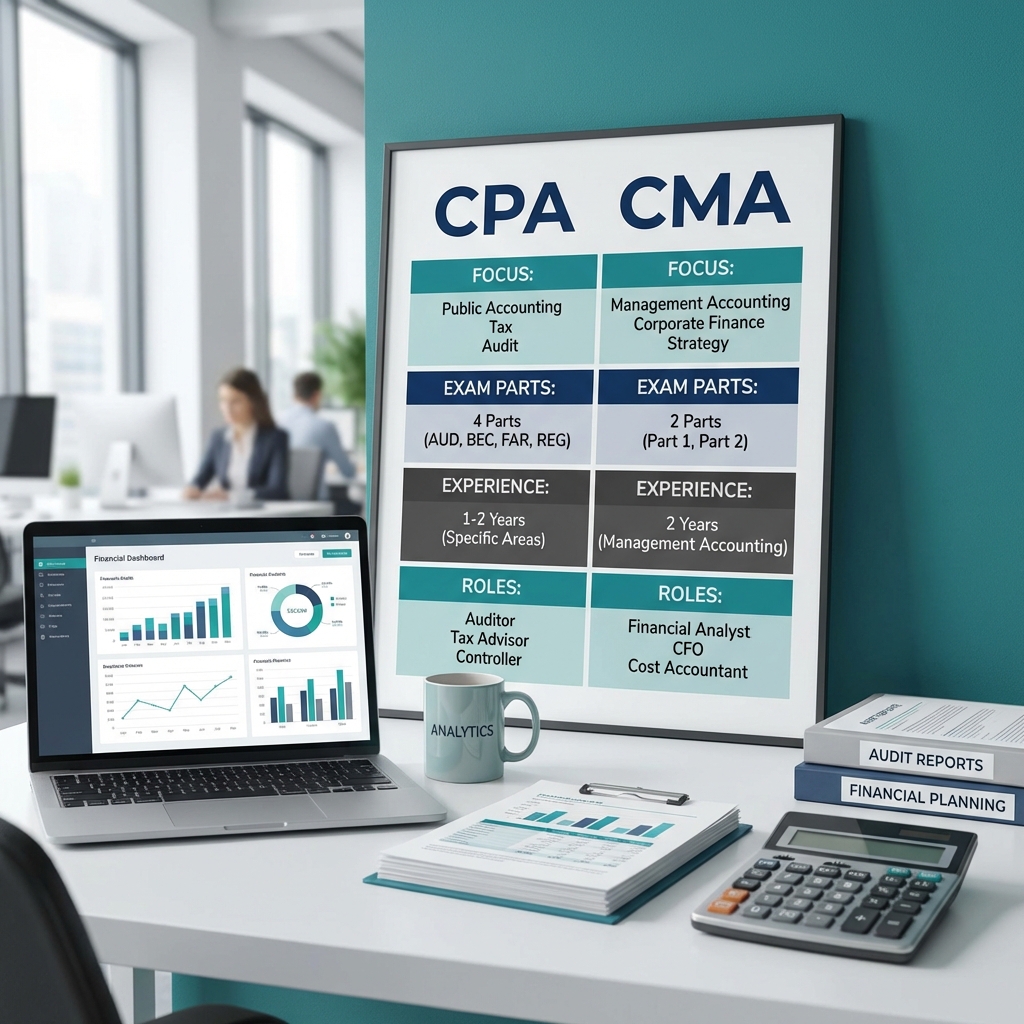
Knowing this link changes how you view homework. You are preparing for your professional credential. When you work through lease schedules in Intermediate II, you study for FAR. When you practice variance analysis in Cost Accounting, you prepare for the BAR discipline exam. For career options, view our comparison on CPA vs CMA certifications.
The Midterm Recovery Protocol: What to Do If You're Failing
If you scored poorly on your first exam, do not panic. Over fifteen years of grading, I have watched hundreds of students turn around low exam scores. Follow this practical three-step plan to get back on track.
Step 1: The 48-Hour Exam Post-Mortem
Within 48 hours of getting your graded exam back, review every missed question. Group mistakes into three categories:
- Bucket A: Simple Math Slips. You typed the wrong key on your calculator, flipped two numbers, or made a subtraction error. Fix: Slow down and verify calculations twice on test day.
- Bucket B: Procedural Missteps. You treated Accumulated Depreciation like a debt, or logged a lease payment as regular expense instead of paying down principal. Fix: Rebuild standard journal entry patterns.
- Bucket C: Missing Core Concepts. You did not know how to handle an intercompany bond or calculate an ROU asset. Fix: Go back to the textbook chapter and review with your professor.
Step 2: The "Show Your Working Paper" Office Hour Strategy
Never enter office hours saying, "I don't understand chapter 12." Instead, rework missed problems on clean paper. Bring that work to your professor and explain your specific question:
"Professor Chen, I reviewed my exam mistakes. I reworked Question 3 on ASC 842 leases. I calculated the present value of lease payments at $142,000, but I got confused on the year-two amortization entry for the right-of-use asset. Here are my T-accounts. Can you show me where my logic broke down?"
This approach shows real ownership. Faculty will gladly tutor students who demonstrate initiative, and they are more likely to round up borderline grades at term end.
Step 3: The Active-Recall Problem Sets Loop
Put down your highlighter. Highlighting text creates an illusion of mastery. Your eyes recognize words, but you cannot solve problems on a blank exam page.
- Close the Textbook: Pick four unassigned end-of-chapter problems where solution keys are available.
- Set a Timer: Set a 25-minute timer. Solve the problems on clean paper without looking at notes.
- Review Your Answers: Compare your entries with the solution guide. If an entry is wrong, write a note explaining why the rule requires that classification.
- Repeat in Two Days: Rework those problems two days later. When you solve them cleanly from memory, you are exam-ready.
Frequently Asked Questions About Difficult Accounting Classes
Here are clear answers to common questions students ask about upper-level accounting courses.
Yes. Most undergraduate business majors find Intermediate Accounting much harder than Corporate Finance. Finance relies on math formulas, market logic, and valuation models. Intermediate Accounting requires strict adherence to thousands of GAAP rules, complex multi-part journal entries, and precise financial disclosures.
Multi-entity consolidations with intercompany eliminations in Advanced Accounting, along with ASC 842 lease calculations and pension accounting in Intermediate II, are considered the hardest topics in university accounting.
Plan for 3 hours of independent study outside class for every 1 credit hour. For a standard 3-credit or 4-credit course, expect to dedicate 9 to 12 hours every week strictly to solving practice problems, reconciling T-accounts, and reviewing rules.
Yes. College exams test academic proofs, theory, and hand-written worksheets. The Uniform CPA Exam tests practical competency through multiple-choice questions and simulations. With disciplined CPA review software, students who earned C grades in college routinely pass the CPA Exam on their first try.