Here's a statistic that stops my intermediate accounting students in their tracks: 98% of companies use the indirect method when preparing their statement of cash flows. Yet every semester, I watch students spend equal time learning both methods, wondering why they're mastering a technique that almost nobody uses in practice.
I get it. You're studying hard. In 14 years of teaching at the University of Texas, I've heard this question about 600 times: "Professor Chen, if both methods give the same answer, why are we learning both?" And honestly? That's the exact right question to ask.
The problem isn't that you're learning both methods. The problem is how you're learning them. Most textbooks treat direct and indirect methods as equals, giving you two parallel paths to the same destination. But that's not how the real world works. Understanding why 98% of companies choose the indirect method isn't just trivia—it's the key to actually mastering cash flow statements.
This guide takes a different approach. Instead of teaching both methods side-by-side, we'll start with the industry standard (indirect), help you understand why it dominates, then show you the direct method as a variation. You'll learn the WHY behind each adjustment, not just the HOW. And you'll avoid the mistakes I see students make every single semester.
What Is the Statement of Cash Flows?
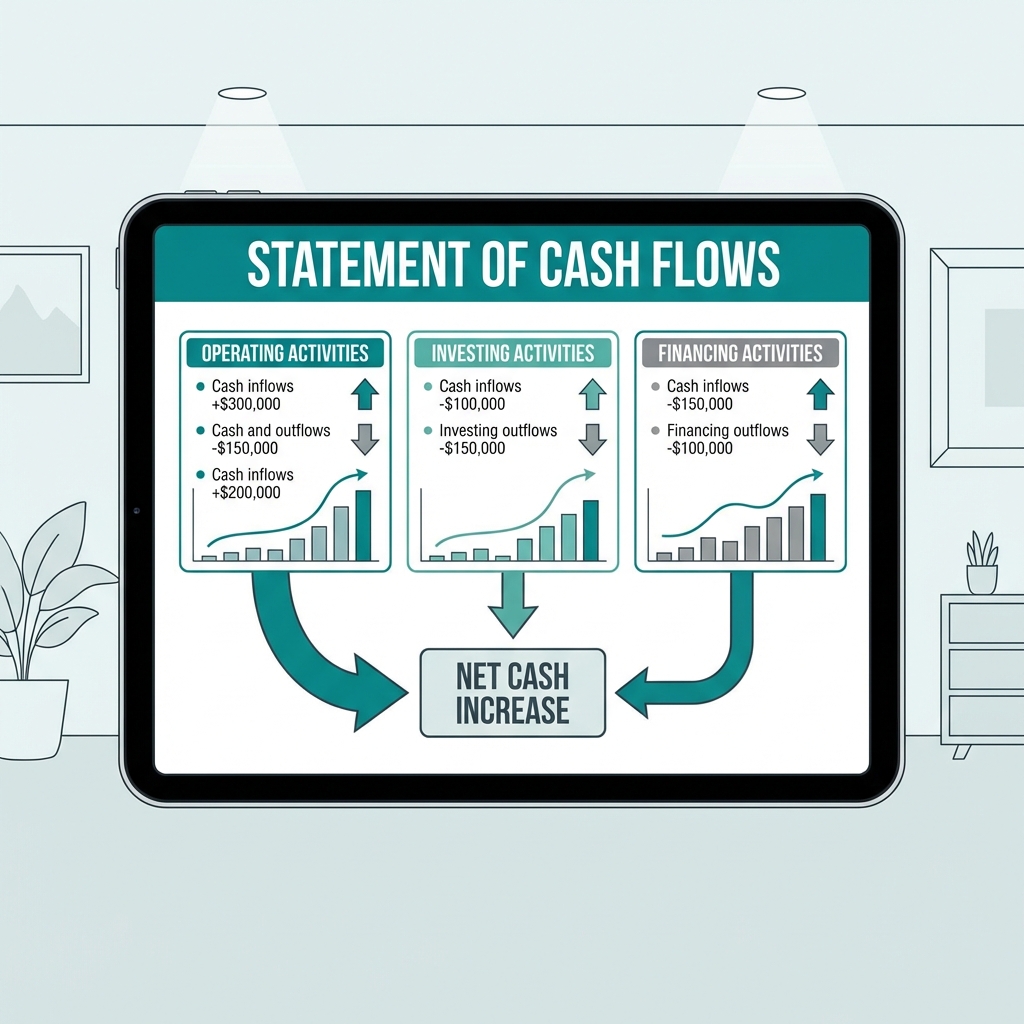
The statement of cash flows is a financial document that tracks the actual movement of cash in and out of a company during a specific period—typically a quarter or a year. Unlike the income statement, which tells you how profitable a company is on paper, the cash flow statement tells you what's happening to the company's most liquid asset: cash.
Think about it this way. You can have an A in your accounting class but be completely broke. Good grades (like good profits) don't pay your rent—actual cash does. Companies face the same reality. A business can show millions in revenue on its income statement while simultaneously running out of cash to pay employees. This disconnect between profitability and liquidity is exactly why the cash flow statement exists.
Why Cash Flow Matters More Than Profit
I'll be honest—when I first learned accounting, I struggled with this concept. Profit seemed like the only number that mattered. But here's what changed my perspective: the 2001 Enron collapse.
Enron reported profits of $979 million in 2000 while burning through cash. Their income statement looked great because of accounting tricks with accruals and deferrals. But the cash flow statement told the real story—they were hemorrhaging cash. Within a year, they filed for bankruptcy. Profitable on paper, but dead because they ran out of cash.
This paradox happens because of accrual accounting. When a company makes a credit sale, it records revenue immediately (increasing profit) even though no cash has come in yet. When it buys equipment, it doesn't expense the full cost immediately—but it does pay the full cash amount upfront. Net income and cash flow can diverge dramatically.
Pro Tip
Think of net income as your grade point average and cash flow as your bank balance. A great GPA doesn't help if you can't afford textbooks. Similarly, a company with strong profits but poor cash flow can't pay its bills, regardless of how good the income statement looks.
The Three Activities: Operating, Investing, Financing
The Financial Accounting Standards Board (FASB) mandated the modern cash flow statement format in 1987 with SFAS 95, replacing the old "statement of changes in financial position." The key innovation? Requiring companies to classify all cash movements into three distinct categories.
Operating Activities represent the cash effects of transactions that enter into the determination of net income. This is your day-to-day business: cash from customers, cash paid to suppliers and employees, interest payments, taxes. If it's part of running your core business, it's operating.
Investing Activities involve cash flows from buying or selling long-term assets. Purchased a building? That's investing. Sold some equipment? Also investing. These are the transactions that change your company's productive capacity.
Financing Activities reflect how the company raises money and pays it back. Issuing stock, borrowing money, paying dividends, buying back shares—anything that changes the company's capital structure lives here.
Now here's where students trip up. Interest paid is operating, not financing, even though it's a financing cost. Why? Because interest affects net income, so it goes where net income lives—in operating activities. Dividends paid are financing because dividends don't hit the income statement. These classification rules seem arbitrary until you understand the logic: if it affects net income, it goes in operating. Period.
Common Pitfall
The #1 student mistake: misclassifying interest and dividends. Here's your decision rule: Interest paid = operating (affects net income). Interest received = operating (affects net income). Dividends paid = financing (doesn't affect net income). Dividends received = operating (affects net income). If you can memorize nothing else, memorize this.
Pro Tip
Memory device I teach my students: "If it touches the income statement, it's operating." Interest expense appears on the income statement, so interest paid goes in operating activities. Dividends don't appear on the income statement (they come from retained earnings), so they're financing. This rule works about 90% of the time.
The beauty of this three-category system is that it tells a story. Strong operating cash flow? The business generates cash from its core operations. Negative investing cash flow? The company is buying assets to grow. Positive financing cash flow? They're raising money. Put them together, and you can see whether a company is funding growth with its own cash or borrowing its way into trouble.
Before we dive into the two methods, you need to understand what you're actually calculating. Both the direct and indirect methods produce the exact same number for cash flow from operating activities—they just use different paths to get there. The investing and financing sections are identical regardless of which method you use. The only difference is in those operating activities.
And that's precisely why 98% of companies choose the indirect method. They're not choosing a different answer—they're choosing an easier path to the same answer. In the next section, we'll explore exactly why that easier path exists and why it matters for you as a student.
The Indirect Method: Industry Standard
Remember that 98% statistic? There's a reason Amazon, Apple, Tesla, and basically every major corporation you can name use the indirect method. And it's not because they're lazy—it's because they're smart about resource allocation.
Take Amazon's 2020 cash flow statement. Their operating cash flow jumped 72% to $66.1 billion that year. How did they calculate that number? Indirect method. They started with net income, added back massive non-cash expenses like depreciation on their warehouse network, and adjusted for their famously negative working capital position (they collect cash from customers before paying suppliers, which is basically a free loan). The entire reconciliation took their accounting team a fraction of the time the direct method would have required.
How the Indirect Method Works
Here's the fundamental insight that makes the indirect method work: net income and cash flow differ because of accrual accounting. Revenue gets recorded when earned, not when cash arrives. Expenses hit the income statement when incurred, not when paid. The indirect method is simply the process of "undoing" these accrual adjustments to get back to cash.
Think of it like this. You get paid a $3,000 monthly salary, but your employer deposits it on the last day of the month. On January 15, you've "earned" about half your salary for the month (that's accrual accounting), but your bank account shows you haven't received any of it yet (that's cash). The indirect method reconciles those two realities.
You start with net income from the income statement—that's your accrual-based number. Then you systematically adjust it to reflect cash by working through three categories of corrections. Each adjustment answers the question: "How did this affect net income differently than it affected cash?"
The Three Categories of Adjustments
After 14 years of teaching this, I've learned that students who master these three categories can prepare cash flow statements in their sleep. Students who try to memorize individual adjustments without understanding the logic? They struggle every single time.
Category 1: Non-Cash Expenses
Depreciation and amortization are the classic examples. Say a company buys a $100,000 truck. Under accrual accounting, they don't expense the full $100,000 when purchased. Instead, they spread it over the truck's useful life—maybe $20,000 per year for five years. But here's the catch: they paid $100,000 cash upfront. The annual $20,000 depreciation expense reduces net income but doesn't touch cash. So we add it back.
Same logic for amortization of intangibles, depletion of natural resources, and stock-based compensation (companies give away stock, not cash, so it goes back in). The rule: if it reduced net income without using cash, add it back.
Category 2: Non-Operating Gains and Losses
This one trips up a lot of students. If you sell equipment for $50,000 and it had a book value of $40,000, you report a $10,000 gain on the income statement. That gain increases net income. But how much cash did you actually receive? $50,000. The full amount goes in investing activities, so you have to subtract the $10,000 gain from net income to avoid double-counting. Losses work in reverse—add them back because they reduced net income but the cash impact was already captured elsewhere.
Category 3: Working Capital Changes
This is where I see the most student confusion, and frankly, where I struggled most when learning this myself. The logic flip-flops depending on whether you're dealing with assets or liabilities, and whether they increased or decreased.
Here's the pattern: When a current asset increases, cash goes down. When a current asset decreases, cash goes up. When a current liability increases, cash goes up. When a current liability decreases, cash goes down.
Why? Let's use accounts receivable. If AR increases by $10,000, you made $10,000 more in sales (increasing net income) but didn't collect the cash yet. So you subtract that $10,000 from net income because it wasn't actually cash. If inventory increases, you bought more stuff (cash out), but the expense doesn't hit the income statement until you sell it, so you subtract the increase. If accounts payable increases, you incurred expenses (reducing net income) but haven't paid cash yet, so you add it back.
Pro Tip
Memory device I teach: AAA and LLL. "Asset Additions Are subtractions" (increased assets reduce cash). "Liability Lifts Lead to additions" (increased liabilities increase cash). It's not elegant, but my students swear this saves them on exams.
Step-by-Step: Preparing Using Indirect Method
Step 1: Start with Net Income
Pull the net income figure straight from the bottom of the income statement. This is your starting point. If net income is $500,000, that's your first line.
Step 2: Add Back Non-Cash Expenses
Scan the income statement for depreciation, amortization, and any other non-cash charges. Add these back to net income. If depreciation was $75,000, you're now at $575,000.
Step 3: Adjust for Gains and Losses
Look for any gains or losses from selling assets. Subtract gains (they inflated net income but cash is captured in investing). Add back losses (they deflated net income but cash impact is in investing).
Step 4: Adjust for Working Capital Changes
Compare beginning and ending balance sheets for each current account. Accounts receivable up $15,000? Subtract $15,000. Inventory down $8,000? Add $8,000. Accounts payable up $12,000? Add $12,000. Keep applying the AAA/LLL rule.
Your final number is net cash provided by operating activities—the same number you'd get with the direct method, but you got here using information that was already sitting in your financial statements.
Common Pitfall
Students constantly flip the signs on working capital adjustments. The most reliable check: ask yourself, "Did this change tie up cash or free up cash?" Inventory increase = tied up cash (you bought stuff) = subtract. Accounts payable increase = freed up cash (you're delaying payment) = add. Logic beats memorization every time.
The Direct Method: Following the Cash
If the indirect method is the practical choice, the direct method is the purist's choice. Instead of starting with an accrual number and adjusting backward, you just... track the cash. Radical, right?
Here's the paradox that makes students crazy: the direct method is simpler conceptually but harder practically. It's like the difference between checking your bank transactions (direct) versus reconciling your checkbook against credit card statements (indirect). The bank transactions are straightforward—you can literally see where money went. But gathering and categorizing every single transaction? That takes dedicated systems.
How the Direct Method Works
The direct method answers one simple question: where did cash actually move? You list major operating cash inflows (cash from customers, interest received, dividends received) and subtract major operating cash outflows (cash to suppliers, cash to employees, interest paid, taxes paid). The difference is your operating cash flow.
No reconciliation from net income. No adding back depreciation. No adjusting for changes in accounts receivable. Just pure, actual cash movements.
So why don't companies use it? Three reasons. First, tracking every cash receipt and disbursement requires sophisticated accounting systems. Second, even if you use the direct method, GAAP requires you to also provide an indirect method reconciliation in the notes—so you're basically preparing it twice. Third, most companies already prepare their income statements and balance sheets using accrual accounting, making the indirect method's data readily available.
But—and this is important—there are legitimate use cases. If you're a CFO managing daily liquidity, the direct method gives you granular insight into exactly where cash is coming from and going. Some companies prepare direct method statements for internal use even though they report indirect method externally.
Pro Tip
For exams and assignments: master the indirect method first. It's what you'll see 98% of the time. Then learn the direct method as "what would this look like if we just tracked cash directly?" Don't try to learn them as equally weighted alternatives—they're not in practice.
Cash Inflows and Outflows
Major Cash Inflows:
- Cash received from customers (sales revenue adjusted for AR changes)
- Interest received on loans or bonds
- Dividends received from investments
Major Cash Outflows:
- Cash paid to suppliers (COGS adjusted for inventory and AP changes)
- Cash paid to employees (wages and salaries)
- Cash paid for other operating expenses (rent, utilities, etc.)
- Interest paid on debt
- Income taxes paid
Notice something? Even with the direct method, you still need balance sheet information to convert accrual amounts to cash. To get "cash from customers," you take sales revenue and subtract any increase in accounts receivable (or add any decrease). For "cash to suppliers," you take cost of goods sold and adjust for changes in inventory and accounts payable. You're not escaping accrual accounting—you're just approaching it from a different angle.
Common Pitfall
Don't confuse the direct method with cash-basis accounting. Cash-basis accounting means you only record transactions when cash moves—no accounts receivable, no accounts payable. The direct method still uses accrual accounting concepts; it just presents the operating section differently. You're still working with the same GAAP-compliant financial statements.
Direct vs Indirect Method: Side-by-Side Comparison
Let's settle this once and for all. Not "which is better?" but "which is better for what?"
| Aspect | Indirect Method | Direct Method |
|---|---|---|
| Starting Point | Net income from income statement | Cash receipts and disbursements |
| Data Source | Income statement + balance sheet | General ledger cash accounts |
| Ease of Preparation | Easier—data already exists in financial statements | Harder—requires detailed transaction tracking |
| Transparency | Less transparent—shows adjustments, not actual cash | More transparent—shows actual cash movements |
| Use in Practice | 98% of companies use for external reporting | Rare in external reports; sometimes used internally |
| Best For | Annual reporting, efficiency, long-term analysis | Daily treasury management, operational insights |
| Regulatory Stance | Permitted and widely accepted | Encouraged by FASB/IFRS but requires additional reconciliation |
| Final Result | Both methods produce identical net cash from operating activities | |
When Each Method Shines
Here's what the comparison table can't fully capture: context matters.
Use the indirect method when you're preparing external financial statements, when you value efficiency over granularity, or when you're analyzing how well a company converts accounting profits into cash. It's the language Wall Street speaks. When Apple reported $105 billion in operating cash flow for fiscal 2023, they used the indirect method. Every analyst understood it. Nobody complained about lack of detail.
Use the direct method when you need to understand exactly where cash is coming from and going to, like a CFO monitoring daily liquidity or a small business owner watching cash carefully. Also use it if you're trying to spot specific operational inefficiencies—maybe collections from customers are lagging, or payments to suppliers could be optimized. The detailed transaction-level view helps here.
For students? Learn indirect method until you can do it without thinking. That's what you'll see on exams, in practice, and in every annual report you analyze. Then understand the direct method well enough to explain why companies don't use it despite regulatory encouragement. That deeper understanding—the why behind the industry preference—is what separates A students from B students.
Pro Tip
CPA exam preparation insider knowledge: multiple-choice questions will test both methods, but simulations almost always use indirect because that's what companies actually do. Practice indirect method for speed and accuracy. Know direct method conceptually for the "why companies prefer indirect" questions.
What's really fascinating—and what most guides won't tell you—is that the whole debate is a bit academic. Both methods answer different questions. Indirect tells you how a company converted its accounting earnings into cash (useful for earnings quality analysis). Direct tells you the actual cash mechanics of operations (useful for treasury management). Smart financial professionals understand that each has its place. The 98% indirect adoption isn't because direct is wrong—it's because indirect is more efficient for the specific purpose of annual financial reporting.
Why Companies Prefer the Indirect Method
Let's address the elephant in the room—the question I get every semester: "If FASB encourages the direct method, why does literally nobody use it?"
The answer comes down to three practical realities that textbooks don't emphasize enough.
Reason 1: The data already exists
Every company prepares an income statement (giving you net income) and a balance sheet (giving you the changes in working capital accounts). The indirect method uses information you already have. You're not creating new data—you're rearranging existing data. For a company like Amazon reporting quarterly, this efficiency matters. Why build a parallel system to track every cash transaction when you can reconcile from net income in a fraction of the time?
Reason 2: You don't need to track individual transactions
The direct method requires accountants to categorize every cash receipt and payment as it happens—was that payment to suppliers? Employees? Operating expenses? With thousands or millions of transactions per period, that's a massive data management challenge. The indirect method sidesteps this entirely. Changes in aggregate account balances (total AR, total inventory) are sufficient.
Reason 3: Even if you use direct, you still need indirect
Here's the kicker that makes the whole debate somewhat pointless: GAAP requires companies using the direct method to also provide an indirect method reconciliation in the notes. You heard that right—use the direct method, and you have to prepare both. The SEC and FASB want to see the reconciliation of net income to cash flow from operations regardless. So companies look at this requirement and ask: "Why prepare two statements when one satisfies the requirement?"
Pro Tip
Focus your study time on mastering the indirect method—it's what you'll see in every actual company report, every case study, and most exam questions. Budget maybe 20% of your cash flow study time on the direct method for conceptual understanding. That 80/20 split mirrors real-world importance.
The median accountant salary in 2024 was $81,680 according to the BLS, with accounting jobs projected to grow 5% through 2034. If you're one of those future accountants, you'll be preparing indirect method cash flow statements. The sooner you get comfortable with that reality, the faster you'll build genuine expertise.
Common Student Mistakes to Avoid
After grading about 2,000 cash flow statement assignments over the past 14 years, I can predict your mistakes before you make them. Not because you're careless—because these errors are counter-intuitive until you understand the underlying logic.
Mistake #1: Misclassifying Activities
This is the #1 error that even Big Four firm professionals make, according to PwC, BDO, and ICAEW audits. It's also the error that costs students the most points on exams.
The classic mistake: putting interest paid in financing activities because "it's a financing cost." Wrong. Interest paid is operating because it affects net income. Same with interest received and dividends received—they're operating activities. Only dividends paid go in financing.
But it gets trickier. Where does the purchase of a building go? Investing. Where does the cash paid for income taxes go? Operating. Where does repaying a bank loan go? Financing. The decision rule: trace it back to which section of the financial statements it affects.
Common Pitfall
Students also misclassify acquisition-related costs and contingent consideration payments. These advanced items trip up even professionals. If you're unsure, ask: "Is this part of running the business (operating), building capacity (investing), or changing capital structure (financing)?" That framework solves 90% of classification questions.
Mistake #2: Wrong Add/Subtract Decisions
I see this constantly: depreciation expense is $50,000, and students subtract it instead of adding it back. Or accounts receivable decreased by $20,000, and they subtract instead of add.
The logic that trips students up: they forget they're reconciling from net income to cash. Depreciation reduced net income by $50,000, but zero cash left the building, so you add it back. If accounts receivable decreased, you collected more cash than your sales revenue suggested, so you add the decrease.
Here's the counter-intuitive part that I struggled with too: increases in current assets reduce cash. It feels backwards. But think about it—if inventory increased by $30,000, you spent $30,000 cash buying stuff that hasn't been expensed yet. Cash went out; net income wasn't affected yet. Subtract it.
Pro Tip
Before submitting any assignment, check these three things: (1) Does depreciation/amortization have a plus sign? (2) Do asset increases have a minus sign? (3) Do liability increases have a plus sign? These three checks catch about 70% of errors I see.
Mistake #3: Including Non-Cash Transactions
Students lose serious points by putting non-cash transactions directly in the statement instead of disclosing them separately.
Example: a company buys equipment worth $100,000 by issuing a note payable. Zero cash moved. This doesn't go anywhere in the operating, investing, or financing sections. It goes in a supplemental disclosure at the bottom: "Non-cash investing and financing activities: Purchased equipment by issuing note payable, $100,000."
Same with stock dividends, exchanges of one asset for another, or converting bonds to stock. If no cash moved, it doesn't hit the statement—it hits the footnotes.
Mistake #4: Not Reconciling
Final critical check: does your net change in cash equal the difference between your beginning and ending cash balances on the balance sheet? If these don't match, you made an error somewhere. This is your built-in verification.
I can't tell you how many students submit assignments where they calculate $75,000 in net cash flow, but the balance sheet shows cash increased by $82,000. That 7,000 discrepancy? That's points lost for not checking your work.
How to Master Cash Flow Statements
Let's talk about how to actually get good at this, not just pass your exam.
The Conceptual Approach
Here's what 2023 research on teaching cash flow statements found: students who focus on conceptual understanding vastly outperform those who memorize procedures. The difference shows up especially on non-routine problems where you can't just apply a formula.
What does conceptual understanding mean? It means asking "why" at every step. Why do we add back depreciation? Because it reduced net income without using cash. Why do we subtract an increase in accounts receivable? Because we recorded revenue but didn't collect the cash yet. Once you understand the why, the how becomes intuitive.
Practice Strategy
Step 1: Master indirect first
Don't split your attention equally between methods. Spend 80% of your practice time on the indirect method until you can prepare one without referring to notes. This is what you'll see in the real world, on exams, and in case studies.
Step 2: Use T-accounts for complex adjustments
For working capital changes that confuse you, draw T-accounts for balance sheet accounts. Track the opening balance, the closing balance, and what must have happened in between. This visual technique helps you see why an inventory increase means cash went out.
Step 3: Work backwards
Once you're comfortable preparing statements forward, do this: take a completed cash flow statement and reconstruct what the income statement and balance sheet changes must have looked like. This reverse engineering cements your understanding of the relationships.
CPA Exam and Academic Tips
For course exams, professors typically test your understanding of: (1) the three categories of adjustments in the indirect method, (2) proper classification of activities, and (3) your ability to handle non-routine items. Expect problems where they give you an income statement, beginning and ending balance sheets, and ask you to prepare the operating section.
For the CPA exam, expect mostly indirect method questions. The exam wants to see that you understand the reconciliation logic, not that you can track individual cash transactions. Common traps include questions where they give you changes in accounts and ask whether to add or subtract, or scenarios where they mix in red herrings like stock dividends that don't affect the statement.
Time-saving technique: on exams, always start by writing down your framework—the three adjustment categories for indirect method. Then work through systematically. Don't jump around. Students who use a consistent process make fewer errors.
Pro Tip
Start every study session by explaining the concept out loud to an imaginary student. If you can't explain why you add back depreciation or why an AR increase gets subtracted without looking at notes, you're not ready. Teaching it is how you know you've learned it.
And if you're genuinely stuck—maybe you've got an assignment due tomorrow and the adjustments aren't making sense—get expert help rather than submitting work you don't understand. Learning from worked solutions by someone who can explain the why behind each step is often more valuable than struggling alone.
Your Next Steps
You started this article wondering why you're learning two methods that produce the same answer. Now you know: 98% of companies use the indirect method not because they're taking shortcuts, but because it's the most efficient way to reconcile accrual accounting with cash reality.
Here's what matters:
- Both methods work — they're just different presentations of the same information. The indirect method dominates practice; the direct method offers transparency that's sometimes valuable for internal management.
- Classification is critical — misclassifying transactions into operating, investing, and financing activities is the #1 error even professionals make. Master the decision rules.
- Logic beats memorization — understand why each adjustment happens, and you'll never forget whether to add or subtract.
- Indirect method first — this is what you'll see in 98% of companies, most exam questions, and every case study. Get comfortable with it before worrying about the direct method.
The accounting job market is growing 5% through 2034 with median salaries around $81,680, but the real career value comes from understanding financial statements deeply enough to analyze company performance. Cash flow analysis separates companies that are genuinely thriving from those just managing earnings with accounting tricks. That's a skill worth having.
Your next step tonight: take a public company's 10-K (try Apple or Amazon—both are on the SEC website), flip to the cash flow statement, and walk through their operating activities reconciliation line by line. See if you can explain why each adjustment was made. That 20 minutes will teach you more than reading three textbook chapters.
And when you're staring at your own assignment at 11 PM wondering if you added back depreciation or subtracted it, remember: the best accountants aren't the ones who never get confused—they're the ones who know how to check their work. Reconcile your statement to the balance sheet changes. Every time.
Need help with your cash flow statement assignment? Our accounting specialists are available 24/7 to help you master both methods, avoid common mistakes, and actually understand what you're calculating. Get expert guidance now.