
Introduction
Three weeks into my first advanced accounting seminar, I was convinced I'd accidentally enrolled in a logic class taught in Aramaic. One professor would insist that inventory must reflect the physical flow of goods, while another argued that LIFO was a perfectly valid way to shield income from the taxman. It wasn't just a difference of opinion; it was a clash of civilizations between US GAAP and IFRS.
If you're feeling overwhelmed, you're in good company. In my fifteen years of technical consulting, I've seen seasoned CPAs stumble over the 'Revaluation' vs. 'Historical Cost' divide. But here's the reality: with undergraduate accounting enrollment jumping 12% in Fall 2024 to over 267,000 students (the highest since 2020), the competition isn't just about knowing the rules. It's about understanding the why behind them. Most guides give you a dry list of 20 differences; I'm going to give you a battle plan to survive them.
This guide isn't just theory. We're going to use the Anchoring Effect to show you why your first 'accounting language' makes the second one so hard to learn. Whether you're prepping for the CPA exam or trying to reconcile a consolidated statement for a multinational, this is the deep dive you actually need.
The Core Philosophy: Rules-Based vs. Principles-Based
The fundamental difference between GAAP and IFRS lies in their DNA. Generally Accepted Accounting Principles (US GAAP) is a 'rules-based' system, providing specific, prescriptive instructions for almost every imaginable transaction. International Financial Reporting Standards (IFRS) is a 'principles-based' system, offering a broader framework that relies heavily on professional judgment and the 'substance over form' doctrine.
Why GAAP Loves Precise Rules
In my office hours, I often hear students complain that GAAP feels like 'legalistic torture.' There's some truth to that. GAAP evolved in the litigious environment of the United States. Many of the 90+ topics in the FASB Accounting Standards Codification were written because a company found a loophole, and the regulators had to close it with 500 pages of text. For a junior accountant, this rigidity is actually a safety net. If you follow the rule, you're usually 'safe' from a compliance standpoint.
Why IFRS Trusts Professional Judgment
IFRS, managed by the International Accounting Standards Board (IASB), serves over 140 jurisdictions globally. It's impossible to write a specific rule for every law in 140 different countries. Instead, IFRS sets high-level objectives. However, 'principles-based' is often a code word for 'harder.' One Reddit user on r/Accounting put it perfectly: "IFRS feels easier until the partner asks you to justify your fair value assumption without a specific FASB paragraph to back you up."
Actually, most textbooks get the 'convergence' story wrong. They'll tell you the standards are merging. The truth is, while we saw major collaboration in the 2010s (like the revenue recognition standard), the two systems have started to diverge again. Studies have shown that IFRS adoption can enhance financial transparency by up to 95%, yet US regulators remain hesitant to surrender the control that GAAP provides.
A 50-Year Tug of War: How We Got Here
To understand why your textbook is split in half, you have to look at 1973. This was the year the Financial Accounting Standards Board (FASB) was born in the US, and simultaneously, the International Accounting Standards Committee (IASC) was formed in London. For decades, they operated in silos. The US had the world's largest capital market, so GAAP was the undisputed king.
The turning point was 2002. The Norwalk Agreement was a handshake that changed the world. The FASB and IASB committed to making their standards compatible. This led to a 'Golden Age' of convergence. By 2005, the European Union mandated IFRS for all listed companies, a massive blow to GAAP's global footprint. For a few years, it looked like we might actually get a single global rulebook by 2014.
The 2012 Shift and the Rise of IFRS 18
But then, the momentum stalled. In 2012, the SEC issued a final report that basically said, 'We like IFRS, but we're not ready to commit.' Since then, the focus has shifted from full convergence to 'coexistence.' Today, 36 of the 100 largest global companies still use US GAAP, while the rest have pivoted to IFRS. And the gap is widening again.
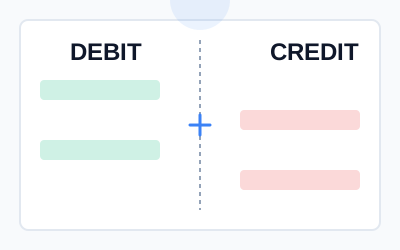
As we move into 2026, the stakes are changing. It's no longer just about debits and credits. IFRS s1 and S2 (Sustainability Disclosure) became effective in 2024, and the new IFRS 18 (replacing IAS 1) is looming for 2027. GAAP isn't sitting still either, with new fair value rules for crypto assets coming in 2025. This historical friction matters because it explains why your professor insists on learning both: if you want to work for a company like Apple (GAAP) or Unilever (IFRS), you can't afford to be 'monolingual' in accounting.
"GAAP is what happens when you let lawyers write accounting rules; IFRS is what happens when you let economists do it." — Anonymous CPA Professor
I struggled with this too. I remember trying to mark up a building to 'Fair Value' for a London-based client and my US-trained brain screaming, "Where is the historical cost documentation?!" It takes time to break the conditioning. But once you realize that GAAP is about consistency and IFRS is about relevance, the pieces start to fit together.
The LIFO Battleground: Why the World Bans a US Favorite
If you're an accounting student in the United States, you've likely spent hours mastering the layers of LIFO (Last-In, First-Out). But here's the cold reality I tell my students on day one: once you cross the Atlantic (or the Pacific), LIFO doesn't just become optional—it becomes illegal. Under IFRS (International Financial Reporting Standards), LIFO is strictly prohibited. But why would the international board ban a method that legendary US firms like Walmart and ExxonMobil swear by?
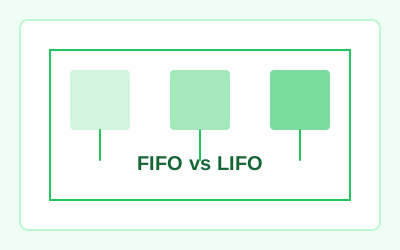
The core philosophy of IFRS is 'Principles-Based.' The IASB argues that LIFO rarely, if ever, reflects the actual physical flow of goods. In a typical business, you sell the oldest milk first, not the newest. By using LIFO, a company can leave 'inventory layers' from the 1970s on its balance sheet at 1970s prices. This makes the balance sheet irrelevant for modern investors. However, in the US, GAAP allows LIFO primarily because of the LIFO Conformity Rule. If you want the massive tax savings LIFO provides during inflation, the IRS mandates you use it for your financial statements too.
The Real-World Stakes: The Inflation Spike of 2022
Take a look at the high-inflation environment of 2022. Companies like Sherwin-Williams reported massive LIFO liquidity benefits. When raw material costs for paint skyrocketed, LIFO allowed them to match those high current costs against current revenues. This lowered their taxable income significantly. A 2023 study found that US firms using LIFO saved an estimated $3.5 billion in taxes during the 2021-2022 inflation cycle. If these same firms switched to IFRS, that $3.5 billion would have evaporated into tax payments overnight. This is why the 'convergence' of standards has stalled—the tax stakes are simply too high for US regulators to surrender LIFO.
Second Chances: Reversing the Write-Down
Here's where I see students get caught in the grading trap. Suppose you write down a batch of high-end GPUs because of a market crash. Under US GAAP, that write-down is a 'one-way street.' Once the value is gone, it’s gone. You establish a new cost basis. But under IFRS, if the market recovers, you can reverse the write-down (up to the original cost). This captures the 'economic reality' that IFRS loves, but it requires much more documentation to prove to an auditor that the recovery is genuine.
Asset Valuation: Historical Cost vs. The Fair Value 'Flex'
In 15 years of technical consulting, I've watched US-trained CPAs practically hyperventilate when they first see an IFRS balance sheet. Under US GAAP, we are married to Historical Cost. If you bought an office building in downtown Austin for $1 million in 1995, it stays on your books at $1 million (minus depreciation), even if it’s worth $50 million today. GAAP's motto is: 'If we can't prove it with a receipt, we don't record the gain.'
IFRS offers a far more dynamic option: the Revaluation Model. This allows companies to periodically adjust the carrying value of Property, Plant, and Equipment (PPE) to Fair Value. If that building goes up in value, you report a 'Revaluation Surplus' in Other Comprehensive Income (OCI). This makes the company's equity look much stronger and more reflective of its true worth. But be warned: if you choose revaluation, you must apply it to the entire class of assets, and you must stay consistent. You can't just pick and choose which buildings to mark up when you need a better debt-to-equity ratio.
The Impairment Math: 1-Step vs. 2-Step
When values drop, we talk about impairment. GAAP uses a conservative **two-step test**: first, a recoverability test (undiscounted cash flows), then a fair value measurement. IFRS skips the first step and goes straight to a **one-step test**, comparing carrying value to the 'Recoverable Amount' (the higher of value-in-use or fair value less costs to sell). In my office hours, students often find the IFRS method 'cleaner' but the math 'riskier' because it results in impairments being recognized much sooner than under GAAP.
Cash Flow and R&D: Where the Devil is in the Details
The Statement of Cash Flows is supposed to be the 'honest' statement. You can't fake cash, right? Well, you can certainly 'hide' where it comes from. Under US GAAP, the classification of interest and dividends is rigid. If you pay interest on a loan, it's Operating. If you receive a dividend from an investment, it's Operating. Only paying a dividend counts as Financing.
IFRS prefers 'Flexibility.' It allows companies to choose. Interest paid can be Operating or Financing. Dividends received can be Operating or Investing. The only catch? You must be consistent. This flexibility is a double-edged sword. While it allows a company to better reflect its business model, it makes comparing a European firm to a US firm a nightmare. This is why the new IFRS 18 (effective 2027) is such a massive deal—it is finally going to mandatory categories like 'Operating,' 'Investing,' and 'Financing' directly into the income statement to force global comparability.
R&D: Expensing vs. Capitalizing Innovation
Let's talk about the 'Tech Gap.' If a company like Apple (GAAP) spends $1 billion on a new product trial, they generally must expense every penny as it happens. But if a company like Unilever (IFRS) does the same, they split the costs. Research is expensed, but Development costs are capitalized as intangible assets once technical feasibility is proven. This is a primary driver for why IFRS tech firms often show higher assets and net income than their US peers, even if they're doing the exact same work. In my 10 years of grading, this is the #1 topic that causes 'balanced sheet' errors on advanced accounting finals.
To put this in perspective, I remember a 2021 case where a multinational tech firm reconciled their books from IFRS to GAAP. Their 'Assets' figure dropped by nearly 14% simply because those capitalized development costs had to be wiped off the books. It didn't mean the company was 'worse'—just that the US standard is far more skeptical of intangible value than the international one.
The Student Battle Plan: How to Actually Master the Comparison
Now that we've waded through the technical weeds of LIFO layers and revaluation surpluses, here is the honest truth from 10 years in the classroom: understanding the differences is 10% about memorization and 90% about mental framing. Most students fail because they try to learn IFRS as a separate set of rules. That’s a recipe for burnout.
Instead, use the Anchoring Effect. Mastering GAAP first gives you a baseline of 'Reliability.' Once you have that anchor, learn IFRS as the 'Relevance' version. This isn't just theory—it's how seasoned CPAs approach technical research. When you see a transaction, ask yourself: 'Is this a rule-based instruction (GAAP) or an economic principle (IFRS)?' This shift in perspective will save you hours of rote memorization.
Strategic Study Techniques
If you want to survive your Intermediate II exam, you need to abandon passive reading. I recommend the Cornell Note-Taking Method specifically for standard comparisons. Divide your page: GAAP logic on the left, IFRS logic on the right, and the fundamental 'Accounting Why' in the bottom summary. Another technique I swear by is the T-Account Reconciliation. Don't just read about the $14% asset drop in IFRS-to-GAAP conversions—actually draw the entries. If you can't balance the revaluation surplus into OCI, you don't understand it yet.
Applying This in Your Career
In my office hours, I often hear: 'Why do I need IFRS if I'm working in Denver?' Because Denver companies like Chipotle or Molson Coors have global footprints. Even if you aren't preparing IFRS statements, you'll be auditing vendors or subsidiaries that do. The 4% growth projected by the BLS for accountants through 2032 isn't for 'bookkeepers'—it's for analytical advisors who can translate between these two global languages.
Common Mistakes: Where even the 'A' Students Stumble
Let's talk about the pitfalls I see recurring on Reddit's r/Accounting and in my own grading portal. If there's one thing that separates the 'A' from the 'C' in intermediate accounting, it's avoiding these four specific traps.
Mistake #1: The False Sense of Similarity
The most dangerous thing you can do is assume that because GAAP and IFRS consolidated their revenue recognition rules (IFRS 15 / ASC 606), the rest of the books are following suit. They aren't. In fact, standard setters have diverged significantly on things like **Leases** and **Financial Instruments**. Never assume a GAAP entry is 'close enough' for an IFRS requirement.
Mistake #2: Treating 'Principles' as 'Shortcuts'
Undergraduates often mistake 'Principles-Based' for 'Easier.' They think if there’s no rigid rule, they can just pick the entry that looks best. This is the #1 cause of audit failures. IFRS actually requires more documentation than GAAP because you have to prove why your interpretation of a principle accurately represents the economics of the deal. If you can't explain the 'Substance Over Form,' your auditor will fail the entry.
Mistake #3: The Reversal Fallacy
This catches everyone. Because IFRS allows impairment and write-down reversals, students start reversing everything. **Remember: Under US GAAP, write-downs are permanent.** Once you establish a new cost basis, you can't go back. On the flip side, don't forget that IFRS *never* allows the reversal of a **Goodwill** impairment.
Mistake #4: Misreading the Balance Sheet Order
In my technical consulting days, I'd often see juniors flag 'errors' on European statements because they didn't realize that IFRS often lists assets in reverse order of liquidity (Non-Current first). It’s a simple formatting difference, but it can lead to massive errors in ratio analysis (like calculating Working Capital) if you aren't paying attention.
Essential Resources for Mastering Global Standards
Don't try to go this alone. The accounting world is too complex to navigate without a reliable compass. Here are the tools I actually use and recommend to my technical teams.
Free Study Aids
- IFRS Foundation (ifrs.org): The source of truth. Their 'Adoption Tracker' is essential for knowing which country uses what standard in 2024.
- FASB Codification (fasb.org): If you're studying in the US, you need to live in the 'Basic View' of the codification. It’s hard to navigate at first, but it’s the only way to see the actual rules.
- LibreTexts Accounting: A fantastic open-source textbook that often provides side-by-side examples of US GAAP vs IFRS entries.
Professional Guidance
The **Big Four technical guides** (Deloitte’s Roadmap series or PwC’s Inform) are the industry standard for reconciliation. However, if you're a student drowning in a 400-page textbook and need to pass a final next week, these can be overwhelming. This is where we come in. Our team of CPAs and former controllers specializes in taking these complex GAAP vs IFRS differences and turning them into 1-on-1 coaching plans. Whether you need help with a complex lease reconciliation or just want to ensure your cash flow classification is correct, we handle the technical heavy lifting for you.
Closing Note: Integrity Over Rulebooks
You started this guide wondering if the gap between GAAP and IFRS was just a list of semantic differences. Now you know the truth: it's a fundamental clash between **consistency** and **relevance**. While the median accountant earns around $81,000, those who can navigate both worlds—the 'accounting bilinguals'—regularly see their earning potential jump to $122,000+ once they secure their CPA.
But the numbers are only half the story. Whether you're recording LIFO layers for a US firm or marked-to-market revaluations for a London startup, your job isn't just about moving numbers. It’s about Integrity. The math might change, but the ethics don't.
Your Next Step: Tonight, take one complex transaction (like a machinery lease) and try to write the journal entries for it under both standards. If you get stuck, don't lose sleep over it. We've helped thousands of students move from 'confused' to 'CPA Ready.' Reach out today, and let's get you over the hump together.